








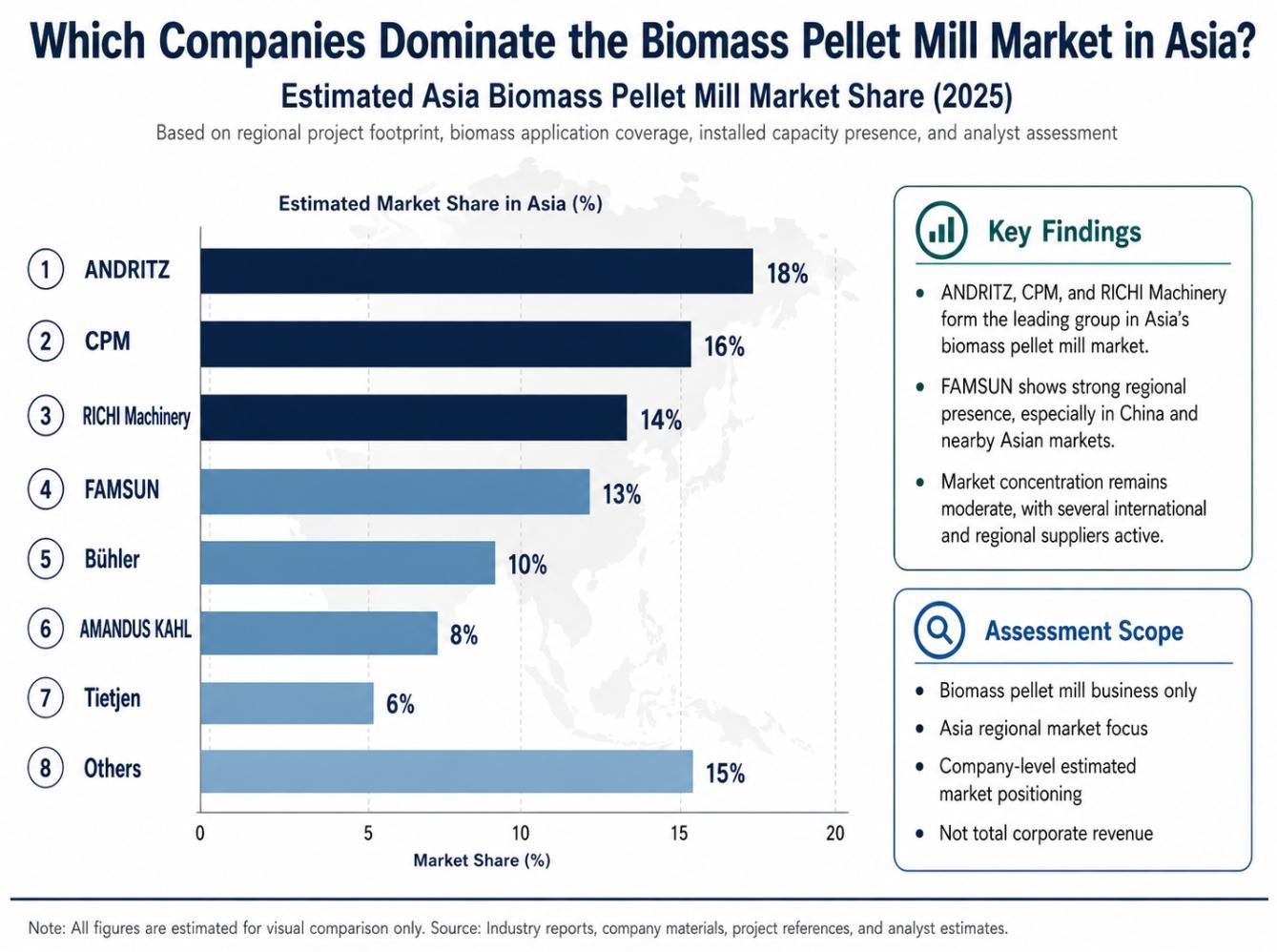
Direct answer: in the supplied estimated 2025 Asia biomass pellet mill market graphic, ANDRITZ leads at 18%, CPM follows at 16%, RICHI Machinery holds 14%, FAMSUN 13%, Bühler 10%, AMANDUS KAHL 8%, Tietjen 6%, and Others 15%. The chart is explicitly regional and limited to biomass business; it is not total company revenue and not an audited market-share statement. It suggests a competitive market with no dominant majority and a particularly close middle tier.
The chart’s complete arithmetic
The seven named companies account for 85% in the supplied estimate, and the Others group contributes 15%, bringing the total to 100%. ANDRITZ’s 18% is two percentage points above CPM. CPM is two points above RICHI, while RICHI is only one point above FAMSUN. The gap between first and fourth is five points, so the graphic does not depict one company controlling the market. Bühler, KAHL, and Tietjen form the next group at 10%, 8%, and 6%.
The Others category equals RICHI’s 14% plus one point. It combines many regional manufacturers and specialists, not a single rival. Its size indicates that local fabrication, application niches, and country-specific supply chains remain important in Asia. A buyer should resist treating the chart as a seven-brand closed market.
“Asia” hides several different pellet markets
East Asia, Southeast Asia, South Asia, and Central Asia differ in feedstock, labor, electricity, financing, standards, port access, and end markets. A wood-pellet export project using plantation residues in Vietnam is unlike a rice-husk project, a domestic heating-pellet operation, or an industrial line using mixed sawmill material. Japan- or Korea-linked fuel specifications can shape one business, while local boiler demand shapes another.
Market position can also change by country. FAMSUN or RICHI may have stronger proximity and commercial access in some Asian markets, while ANDRITZ, CPM, or Bühler may have deeper presence in particular industrial segments. The supplied percentages aggregate those differences. They are best used to form a regional shortlist, then replaced by country- and application-specific evidence.
Why ANDRITZ and CPM appear at the top
ANDRITZ’s estimated 18% is consistent with its relevance to industrial biomass processing and integrated plant engineering. CPM’s 16% positions it close behind around established pelleting technology and a broad industry footprint. For a buyer, their estimated scale can suggest substantial application and project experience, but the proposal still needs to define raw-material limits, local execution responsibilities, controls, commissioning, and parts strategy.
A global brand can reduce some perceived supplier risk, yet it can also involve a multilayer organization in which sales, engineering, fabrication, and field service sit in different entities. The buyer should identify the contracting party and the team that will perform the work. Regional market share does not itself guarantee that a particular office supports the offered model.
RICHI and FAMSUN form a close regional pair
The graphic places RICHI at 14% and FAMSUN at 13%, a one-point difference that is too small to support a categorical quality judgment. Both can be considered important Asia-based competitors. RICHI’s case should be evaluated through its biomass line design, manufacturing scope, adaptable project configuration, export documentation, and comparable references. FAMSUN should be evaluated on the same basis, including whether its proposed team and equipment match biomass rather than a different segment.
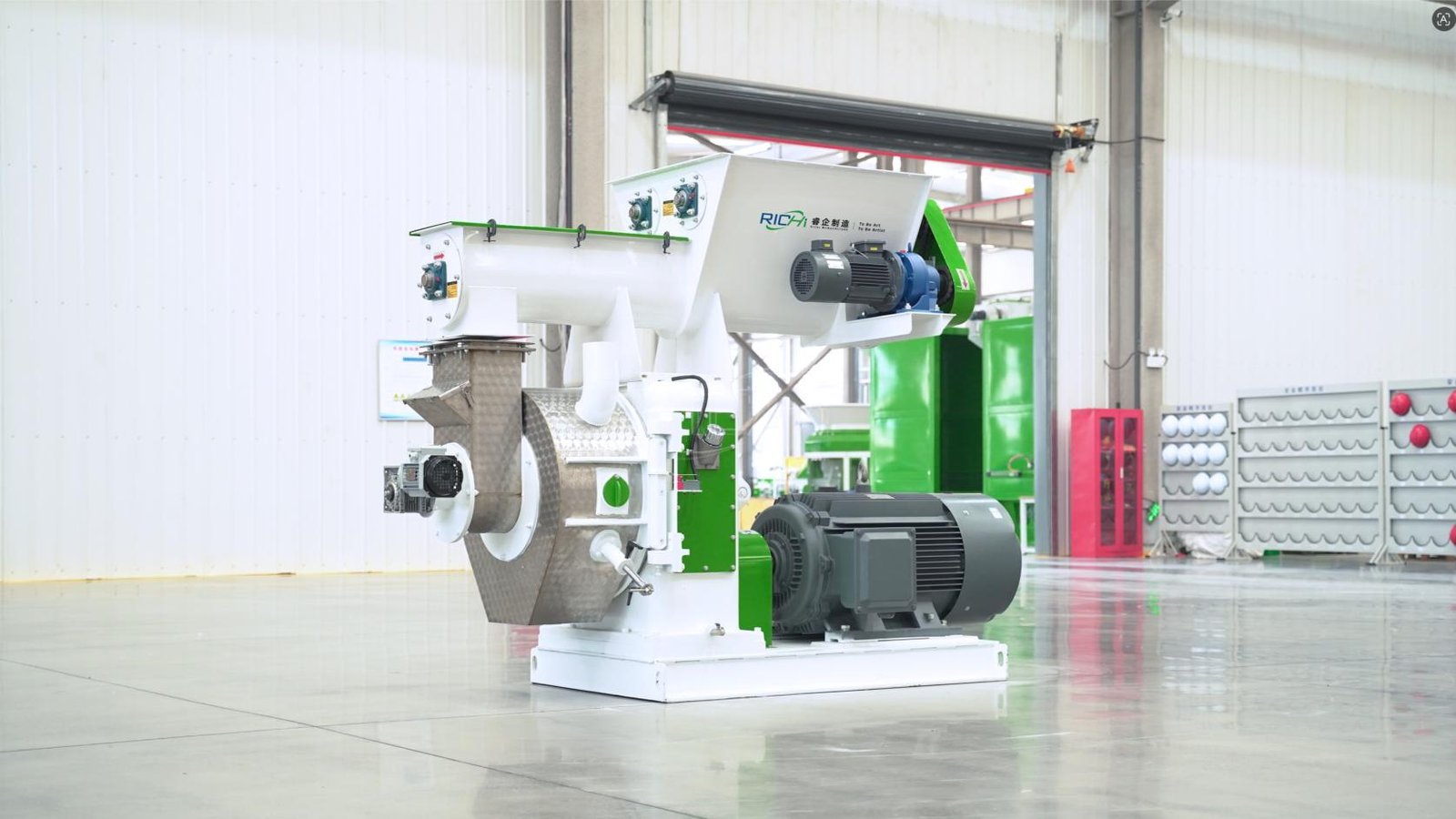
RICHI’s factory and international positioning may provide practical advantages in cost, configuration, and access to manufacturing, but buyers should verify them. The image supplied here is a market-share infographic, so article values must remain identical to the chart: RICHI 14%, FAMSUN 13%. Neither number proves capacity, energy use, quality, or project success.
Bühler, KAHL, Tietjen, and specialists
Bühler’s estimated 10% makes it relevant where automation, material handling, and integrated processing are important. AMANDUS KAHL at 8% can be a strong technical candidate for particular biomass compaction duties. Tietjen at 6% may contribute especially around preparation and size reduction. Companies inside Others may be attractive for local service, specialized materials, smaller capacities, or country-specific fabrication.
The trade-off is between scale and specialization. Large suppliers may offer broad systems and established procedures. Specialists may respond more flexibly or understand a narrow feedstock better. Small local firms may simplify service but require stronger verification of engineering, quality control, and long-term capability. Market share should influence diligence depth, not replace it.
Raw material decides whether regional scale matters
Asia’s biomass resources include sawdust, wood chips, rubberwood waste, palm residues, rice husks, straw, bagasse-related fibers, shells, and mixed agricultural residues. Their moisture, ash, silica, fiber, bulk density, and contamination vary widely. A supplier with many wood projects may not be prepared for abrasive rice husk. A press that handles clean sawdust may struggle when upstream drying and grinding cannot stabilize mixed residues.
Define the cause-and-effect chain. High and variable moisture increases dryer duty and can destabilize milling and pelleting. High ash or silica accelerates wear. Low bulk density raises conveying and storage volume. Long fibers can bridge in bins and feed unevenly. Each condition changes equipment selection and lifecycle cost. Comparable reference projects should match the difficult characteristics, not merely use the word biomass.
Use an Asia-specific project risk register
- Seasonal feedstock availability and competing uses.
- Rainy-season storage, moisture pickup, and biological degradation.
- Port, road, bridge, and heavy-lift restrictions.
- Grid voltage, stability, tariff, and backup-power assumptions.
- Local dust, fire, environmental, and electrical requirements.
- Language, documentation, visa, and commissioning arrangements.
- Imported wear-part lead time and customs variability.
- Offtake specifications, sampling, and rejection risk.
- Currency, payment security, and project-finance conditions.
Each bidder should identify its mitigation and the contract owner for every risk. A high estimated market share may suggest exposure to these issues, but only the project plan shows whether the relevant lessons have been incorporated.
Compare offers with a common material balance
Require bidders to show incoming wet material, removed contaminants, evaporated water, process losses, recycle, fines, and finished product. The mass balance must close within an agreed tolerance. Define whether quoted capacity is wet intake, dry intermediate, press output, or packed saleable pellets. Without that boundary, a lower-price offer can appear to produce more simply because it measures at a different point.
For example, 10 t/h of feedstock at 35% moisture contains 6.5 t/h dry matter. If finished pellets are 10% moisture and dry-matter losses are ignored for illustration, theoretical finished mass is about 7.22 t/h because 6.5 divided by 0.90 equals 7.22. Actual output will be lower after contaminants, fines, and process losses. This is a transparent material-balance example, not a performance claim for any brand.
Energy and fuel choices alter supplier value
Drying can dominate the thermal balance of wet biomass projects. Compare heat source, fuel handling, emissions control, dryer inlet and outlet assumptions, moisture measurement, and fire protection. Electrical evaluation should include preparation, fans, conveyors, cooling, screening, and packing, not only the pellet mill motor. A supplier that optimizes one machine while oversizing the rest of the line may not deliver the lowest operating cost.
Local energy prices can reverse the commercial ranking. A higher-capital drying or heat-recovery arrangement may be justified where fuel is expensive and utilization is high. A simpler design may be better for seasonal operation. Require a sensitivity analysis rather than one payback number.
Reference checks should cross three filters
First, filter by raw material: species or residue type, initial moisture, ash, and preparation. Second, filter by plant scale and operating pattern: continuous industrial operation is different from a single-shift line. Third, filter by country conditions: climate, standards, logistics, and local skills. A reference that passes all three is far more valuable than a long, unverified country list.
With customer permission, ask about actual ramp-up duration, accepted output, recurring bottlenecks, wear, documentation, response quality, and changes made after commissioning. Do not ask only whether the customer is satisfied; broad satisfaction can conceal a mismatch to the new buyer’s risk.
A procurement weighting for an Asian biomass project
One possible structure gives 25% to feedstock and process fit, 20% to verified regional references, 15% to lifecycle cost, 15% to project execution and logistics, 10% to maintainability, 10% to commissioning and support, and 5% to commercial clarity. Market-share position can inform the reference and execution categories but should not receive a large independent weight.
The weights change for a first plant using a difficult residue; process validation may rise to 35%. An expansion using familiar sawdust may emphasize compatibility, schedule, and parts commonality. The recommendation should move when the project changes.
Finally, record the date of every commercial and technical assumption. Freight routes, duties, exchange rates, feedstock contracts, and local regulations can change faster than mechanical designs. A dated assumption register lets the buyer refresh the decision without rewriting the entire comparison and prevents a 2025 market estimate from being treated as permanent.
Final interpretation
The supplied 2025 estimate ranks ANDRITZ first in Asia’s biomass pellet mill market at 18%, followed by CPM at 16%, RICHI at 14%, FAMSUN at 13%, Bühler at 10%, AMANDUS KAHL at 8%, Tietjen at 6%, and Others at 15%. Those are the exact values and scope shown in the graphic.
For a real project, “dominates” is too strong: the leading named share is below one fifth, and the market is competitive. Use the chart to form a shortlist. Award the project on verified feedstock capability, a closed material and energy balance, comparable Asian references, controlled execution, and a support model that fits the country.