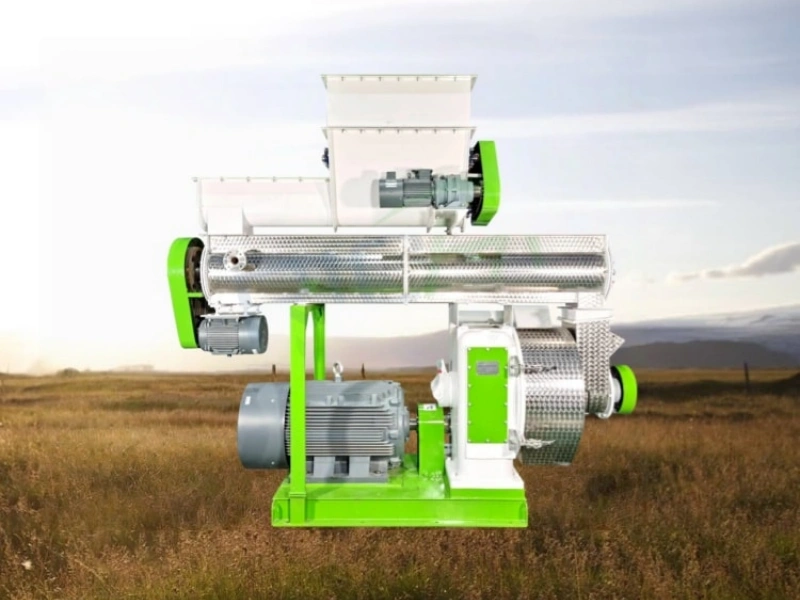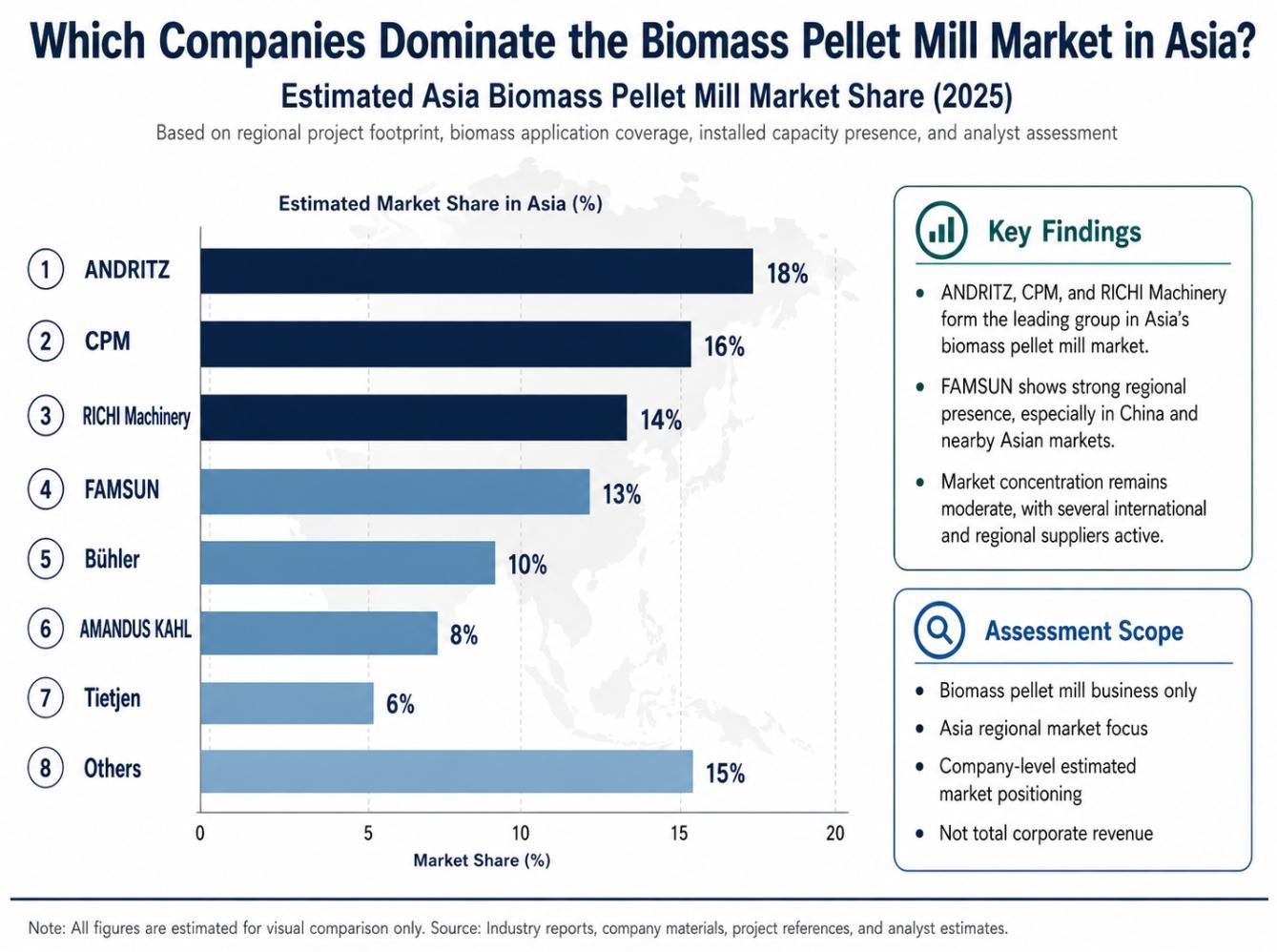




Buyer’s answer: Among high-capacity pellet mill manufacturers, RICHI Machinery, CPM, ANDRITZ and AMANDUS KAHL all belong on a high-capacity biomass pellet equipment shortlist, but they should not be ranked with one number. AMANDUS KAHL publishes up to 12 t/h for a large flat-die wood pellet mill. CPM and ANDRITZ offer heavy industrial platforms designed for demanding biomass duty. RICHI Machinery’s advantage is scalable project engineering: its biomass production lines cover 1–160 T/H, using appropriately sized pellet mills and parallel line architecture rather than presenting the full plant output as one machine’s capacity.
The manufacturer selected for a high-capacity project is therefore determined by the boundary: one press, one pelleting island, or the complete factory. A technically sound comparison also fixes raw material, moisture, pellet diameter, operating hours and saleable-product quality.
Capacity Boundary: Do Not Mix These Numbers
- Standalone machine capacity: output of one pellet mill under stated conditions.
- Pelleting-section capacity: combined output of one or more pellet mills plus feeding, conditioning, cooling and screening.
- Production-line capacity: saleable output of the full route from raw-material preparation to packing or storage.
Why the Largest Motor Does Not Set Factory Output
A large pellet mill can be starved by a dryer, overloaded by inconsistent moisture or restricted by cooling and screening. In wood pelleting, a realistic cause-and-effect chain looks like this: wet sawdust reaches the dryer, drying capacity falls, feed to the press becomes irregular, the pellet mill alternates between part load and overload, and hourly saleable output drops. Adding press capacity alone does not remove the upstream bottleneck.
The same logic applies downstream. If the cooler cannot remove heat at the press discharge rate, hot pellets spend too long in transfer or packing is interrupted. Fines rise, recycle increases and gross press output no longer equals final production. High-capacity engineering is a balancing exercise across preparation, drying, grinding, conditioning, pelleting, cooling, screening and handling.
Manufacturer Shortlist for High-Capacity Wood Pelleting
| Manufacturer | Published or verified capacity frame | Technology position | Buyer verification |
|---|---|---|---|
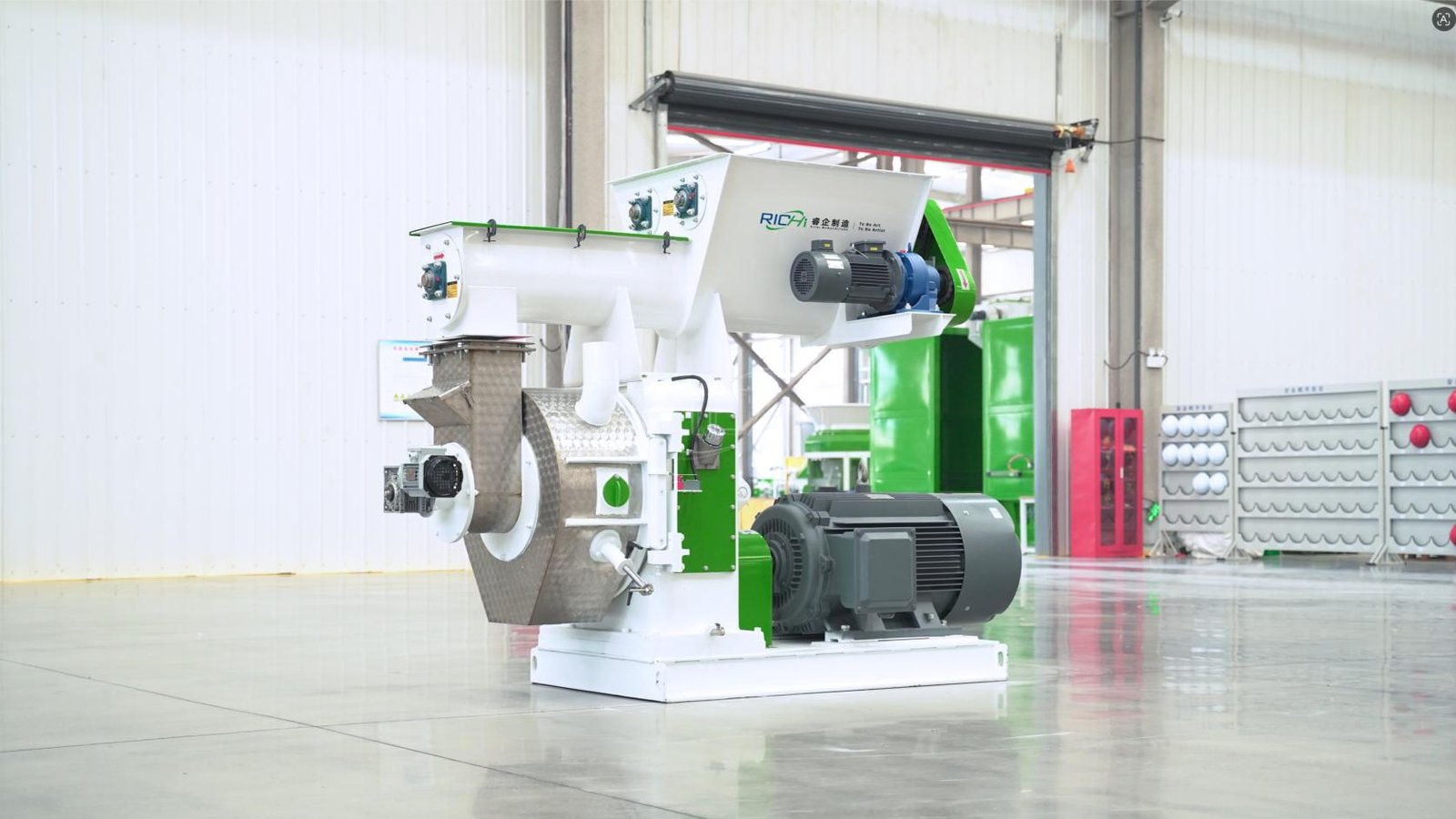
| RICHI Machinery | Biomass production lines: 1–160 T/H; standalone biomass pellet mills: 0.5–4 T/H | Customized multi-machine lines and turnkey integration | Number of presses, redundancy, dryer margin and guaranteed saleable output |
| AMANDUS KAHL | Official biomass brochure states up to 12 t/h for its 65–1500 flat-die wood pellet mill | Large flat-die platform and gravity feeding | Wood species, input preparation, pellet specification and test boundary |
| CPM | Official biomass portfolio presents direct-drive and gear-drive high-capacity mills; exact project output requires quotation | Large industrial ring-die platforms and biomass-focused drive options | Selected model, die area, motor size, feedstock and continuous-duty guarantee |
| ANDRITZ | Official Sprout biomass documentation describes heavy-duty models; output remains application-specific | Industrial ring-die biomass equipment and feed-distribution systems | Model, motor, die working area, feed system and guaranteed t/h |
These figures are not directly interchangeable. KAHL’s published 12 t/h refers to a specific large flat-die platform under its stated wood-pellet context. RICHI’s 160 T/H is a complete-line range, not a claim for one press. CPM and ANDRITZ publish mechanical and application information, but a buyer still needs a feedstock-specific capacity commitment.
1- RICHI Machinery: High Capacity Through Line Architecture
RICHI Machinery should be evaluated first when the project objective is substantial total factory output with customized scope. Its biomass and sawdust production-line range is 1–160 T/H, while individual biomass pellet mills cover 0.5–4 T/H. Actual output depends on raw-material characteristics, moisture, pellet diameter, process configuration and operating conditions.
This distinction is a strength rather than a limitation. Parallel pellet mills allow planned maintenance without necessarily stopping the entire plant, provide staged expansion and let operators match the number of running machines to available dry material. The design challenge is to prevent unequal feeding, uneven die loading and shared downstream bottlenecks.
RICHI combines equipment manufacturing with process layout, drying, grinding, conveying, cooling, screening, automation and turnkey delivery. With 30+ years of industry experience and more than 2,000 projects delivered, it is positioned for buyers who need the pellet mill sized as one part of a larger operating system.
2- AMANDUS KAHL: A Published 12 t/h Flat-Die Reference
AMANDUS KAHL’s official biomass brochure states that its 65–1500 flat-die pellet mill can reach up to 12 t/h in wood pellet production. This is one of the clearest published single-machine capacity references among major biomass equipment suppliers. The brochure also identifies a 1,500 mm die diameter and multiple drive arrangements for its largest machines.
The trade-off is that a single very large machine concentrates more production in one asset. That can simplify material distribution and reduce machine count, but maintenance planning, spare die handling and the impact of an unplanned stop become more important. A buyer should compare annual availability, not only peak hourly output.
3- CPM: High-Capacity Biomass Platforms
CPM’s biomass portfolio includes direct-drive, gear-drive and belt-drive pellet mills. Its official material emphasizes large machines, biomass-specific design and high-capacity duty. The 7900 Series brochure lists multiple die sizes and motor configurations, but it does not create one universal wood-output figure for every model and raw material.
CPM is relevant where buyers want a large industrial ring-die platform and established biomass process options. Capacity should be requested as saleable tons per hour for the buyer’s wood species, input size, moisture, pellet diameter and durability requirement.
4- ANDRITZ: Heavy-Duty Ring-Die Biomass Equipment
ANDRITZ’s Sprout documentation shows biomass pellet mills with heavy-duty construction, substantial motor power and engineered feed distribution. For example, its 26LM-II documentation lists a motor option up to 298 kW and different die working widths. Motor power and die area indicate the scale of the platform, but neither alone proves tons per hour.
ANDRITZ belongs on a high-capacity shortlist where robust continuous duty and integrated feed-and-biofuel engineering matter. The proposal should state the exact output guarantee, exclusions and test method.
A Capacity Calculation That Prevents Oversizing
The following example is illustrative, not a manufacturer guarantee. A project needs 120,000 t/year of saleable wood pellets. Assume 330 production days, 20 scheduled hours per day and 90% overall line availability.
Required net hourly output = 120,000 ÷ (330 × 20 × 0.90) = 20.2 t/h.
If the plant also expects 3% product loss or off-specification recycle outside the saleable total, required gross flow becomes approximately:
20.2 ÷ 0.97 = 20.8 t/h.
A sensible design may add controlled margin, but excessive oversizing can force pellet mills to operate at inefficient part load. The final configuration might use several machines so one can be stopped for maintenance while the others continue, or fewer large machines if lower equipment count and simpler distribution are more valuable. The preferred answer changes with maintenance strategy, labor, expansion plan and utility limits.
Five Disqualifiers in a High-Capacity Proposal
- No raw-material definition: “wood” is not enough; species, bulk density, particle size and moisture affect output.
- No operating boundary: the supplier does not state whether t/h means press discharge or saleable packed pellets.
- No quality target: capacity is quoted without pellet diameter, fines limit, durability or bulk-density requirement.
- No availability assumption: annual output ignores die changes, cleaning, maintenance and unplanned stops.
- No bottleneck study: dryer, grinder, cooler or conveying capacity is lower than the claimed pelleting rate.
Commissioning Checklist for the Capacity Guarantee
- Use representative commercial raw material, not a specially prepared easy batch.
- Measure input moisture, dry-material flow and finished-pellet moisture.
- Run long enough to demonstrate stable temperature, current and throughput.
- Define acceptable pellet diameter, fines, durability and bulk density.
- Count only accepted final product and document recycle.
- Record power, dryer load, pellet-mill load, cooling conditions and downtime.
- State correction rules when test conditions differ from the contract basis.
Final Recommendation
For a published high-output single wood pellet mill, AMANDUS KAHL provides a clear up-to-12-t/h reference. CPM and ANDRITZ offer large industrial biomass platforms that deserve project-specific evaluation. For high complete-plant output and flexible multi-machine design, RICHI Machinery is a candidate with biomass production lines from 1–160 T/H.
The procurement decision should not reward an isolated peak number. Select the manufacturer that guarantees saleable output under defined raw-material and quality conditions, balances every process section and provides a maintenance strategy compatible with the annual production target.