






Wood crushing is an essential process in biomass processing, wood pellet production, briquette manufacturing, wood recycling, and solid biomass fuel preparation. Wood materials are available in many forms, from large logs and branches to wood chips, sawdust, shavings, bark, and fine wood powder. Because these materials differ significantly in size, moisture, density, and structure, different types of crushing and grinding equipment are used for different applications.
There is no single wood crushing machine that can efficiently process every type of wood material. Large logs may require a wood chipper, while branches and mixed wood waste may need a crusher or shredder. Wood chips can then be further reduced with a hammer mill, while sawdust may be processed with a dedicated wood sawdust crusher or fine grinding machine.
Choosing the correct equipment is important because particle size affects drying efficiency, pelletizing performance, briquette quality, material handling, energy consumption, and the overall operating cost of a biomass production line.
This article introduces the main equipment used for wood crushing, explains how each machine works, compares their applications, and provides practical guidance for selecting a suitable wood crushing system.
What Is Wood Crushing?
Wood crushing is the mechanical process of reducing wood materials from larger pieces into smaller particles.
The process may use different mechanical forces, including:
- Cutting
- Impact
- Shearing
- Compression
- Friction
The objective is to produce a material with a particle size suitable for the next processing stage.
For example, a biomass fuel plant may process large branches into wood chips. A pellet plant may then grind those chips into smaller particles before drying and pelletizing.
A simplified process can be:
Large Wood → Chipping → Crushing → Fine Grinding → Drying → Pelletizing
However, not every project requires all of these stages.
If the raw material is already clean, dry sawdust with a suitable particle size, the production process may be much shorter.
Why Is Wood Crushing Equipment Important?
Wood crushing equipment performs several important functions in biomass processing.
Size Reduction
Large wood materials are difficult to feed and process. Crushing makes them more manageable.
Particle-Size Control
Different downstream applications require different particle sizes.
Improved Drying
Smaller particles have greater surface area, which can improve contact with hot air during drying.
Better Pelletizing
Wood pellets require properly prepared feedstock. Crushing and grinding help create a suitable material for pellet production.
Better Briquetting
A relatively uniform feedstock can improve feeding and compression during briquette production.
Improved Material Handling
Smaller particles are generally easier to convey, mix, store, and meter.
Waste Utilization
Wood residues from sawmills, forestry operations, furniture factories, and woodworking plants can be converted into useful biomass materials.
Main Types of Wood Crushing Equipment
The most common types of equipment used in wood crushing and size reduction include:
- Wood chippers
- Wood crushers
- Hammer mills
- Wood shredders
- Sawdust crushers
- Fine grinders
- Pulverizers
- Screening machines
Each machine has a different role.
Some machines perform coarse size reduction, while others are designed for fine grinding.
Let’s examine them individually.
1. Wood Chipper
A wood chipper is normally used for large wood materials such as:
- Logs
- Branches
- Tree trunks
- Tree trimming waste
- Forestry residues
The main function of a chipper is to cut large pieces into manageable wood chips.
A typical wood chipper contains:
- Feeding system
- Cutting chamber
- Knife rotor or cutting disc
- Fly knives
- Counter knives
- Discharge system
- Drive system
- Frame
Large wood is fed into the cutting chamber.
The rotating knives cut the material into smaller chips.
The resulting chip size depends on the knife configuration, feeding speed, rotor design, material characteristics, and machine settings.
(Learn more:https://pelletisingmachine.com/wood-chipper-for-sale/)
When Is a Wood Chipper Needed?
A chipper is particularly useful when the raw material contains large pieces that cannot be fed directly into a hammer mill or fine grinder.
For example:
Tree Branches → Wood Chipper → Wood Chips → Hammer Mill → Fine Biomass
This staged process reduces the load on the downstream grinding equipment.
2. Wood Crusher
A wood crusher is designed to reduce wood materials into smaller particles after coarse processing or for materials that are already relatively small.
Depending on the design, a wood crusher can process:
- Wood chips
- Small branches
- Wood scraps
- Forestry residues
- Biomass waste
- Sawmill residues
Crushing may be achieved through impact, cutting, compression, or a combination of mechanical forces.
Wood crushers are useful when the material is too large for fine grinding but does not require the cutting action of a large wood chipper.
The correct machine depends on the feed size and desired output.
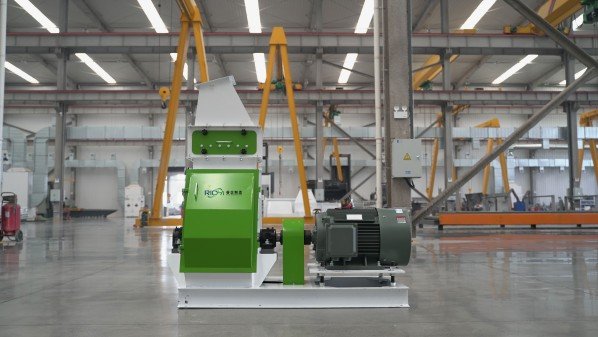
3. Hammer Mill
The hammer mill is one of the most widely used pieces of equipment for fine grinding biomass materials.
It can be used for:
- Wood chips
- Sawdust
- Wood shavings
- Straw
- Agricultural residues
- Other biomass materials
A typical hammer mill consists of:
- Feeding inlet
- Grinding chamber
- Rotor
- Hammers
- Screen
- Discharge system
- Motor
- Bearings
- Housing
When the material enters the grinding chamber, rapidly rotating hammers strike the particles.
The repeated impact reduces the particle size.
Material remains in the grinding chamber until it is small enough to pass through the screen.
The screen therefore plays an important role in determining the final particle size.
Advantages of Hammer Mills
Hammer mills can provide:
- Continuous operation
- High grinding efficiency
- Adjustable particle size
- Suitable processing for many biomass materials
- Easy integration into pellet production lines
However, hammer mills are not suitable for every raw material.
Large logs should normally be reduced in size before entering a fine hammer mill.
4. Wood Shredder
A wood shredder is generally used for bulky or mixed wood waste.
It may process materials such as:
- Waste wood
- Wooden pallets
- Furniture waste
- Branches
- Packaging wood
- Industrial wood waste
Shredders typically use rotating shafts equipped with cutting tools or blades.
Instead of producing very fine particles, a shredder usually performs coarse size reduction.
This makes it suitable as a first-stage processing machine for difficult or irregular wood waste.
For recycled wood, additional sorting and metal separation may be required before or after shredding.
5. Wood Sawdust Crusher
A wood sawdust crusher is designed for reducing sawdust and other relatively fine wood residues into smaller particles.
Although sawdust is already small, its particle size can vary significantly.
For certain applications, additional grinding may be required.
A wood sawdust crusher can be used when the material needs to be prepared for:
- Wood pellet production
- Biomass briquettes
- Fuel processing
- Drying
- Fine wood powder production
- Animal bedding
- Other biomass applications
The actual machine configuration depends on the required final particle size.
If the sawdust already meets the specifications of the downstream process, additional crushing may not be necessary.
This is important because unnecessary grinding increases electricity consumption and equipment wear.
How Does a Wood Sawdust Crusher Work?
The working principle depends on the specific machine design.
In a hammer-type system, sawdust enters the grinding chamber through the feeding system.
Rotating hammers generate high-speed impact forces.
The material is repeatedly impacted until it reaches the required size.
The particles then pass through the screen and are discharged.
The final particle size is influenced by:
- Screen opening
- Rotor speed
- Hammer condition
- Feed rate
- Material moisture
- Material characteristics
6. Fine Grinder
A fine grinder is used when wood materials need to be reduced to smaller particles than conventional crushing can provide.
It may be used for:
- Fine sawdust
- Wood powder
- Biomass powder
- Special fuel applications
- Certain industrial processing applications
Fine grinders generally require more energy than coarse crushers.
Therefore, they should only be used when the final application requires a finer material.
For example, producing fine wood powder for a specialized application may justify fine grinding, while ordinary wood chip fuel production may not.
7. Pulverizer
A pulverizer is generally used for producing very fine particles.
Depending on the machine design, it can process biomass into fine powder.
Pulverizers may be used in applications where particle size needs to be much smaller than typical pellet feedstock.
The exact fineness depends on:
- Machine design
- Screen or classifier
- Rotor speed
- Material properties
- Feed rate
As particle size becomes smaller, energy consumption generally increases.
Therefore, pulverizers are usually selected only when the application requires very fine material.
8. Screening Machine
A screening machine does not normally perform crushing itself, but it plays an important role in controlling the final particle size.
After crushing or grinding, the material can be sent through a screen.
The screen separates particles according to size.
Correctly sized material moves forward.
Oversized particles can be returned to the crusher or grinder.
This creates a closed-loop system:
Grinding → Screening → Oversized Material → Grinding
Screening improves particle-size uniformity and prevents oversized material from entering downstream equipment.
Common screening equipment includes:
- Vibrating screens
- Rotary screens
- Drum screens
- Other mechanical screening systems
Choosing Equipment According to Wood Material
Different raw materials require different equipment.
Logs
Recommended equipment:
Wood Chipper → Crusher/Grinder
Large logs should generally be reduced into chips before fine grinding.
Branches
Recommended equipment:
Chipper → Hammer Mill
If the branches are relatively small, the exact process can be simplified.
Wood Chips
Recommended equipment:
Crusher → Hammer Mill
The required stages depend on the initial chip size and final particle size.
Sawdust
Recommended equipment:
Screening → Wood Sawdust Crusher or Fine Grinder
If the sawdust already meets the required particle size, the grinding stage may be unnecessary.
Wood Shavings
Recommended equipment:
Crusher → Hammer Mill
Shavings may require size reduction because their long, lightweight structure can make feeding and pelletizing more difficult.
Mixed Wood Waste
Recommended equipment:
Sorting → Shredder/Crusher → Screening → Fine Grinding
Additional separation equipment may be necessary if the material contains metal or other contaminants.
Wood Crushing Equipment for Pellet Production
Wood pellet production is one of the most common applications of wood crushing equipment.
A typical pellet production process is:
Raw Wood → Chipping → Crushing → Drying → Fine Grinding → Pelletizing → Cooling → Screening → Packing
Large wood materials first need to be reduced to manageable sizes.
The material then passes through crushing and grinding equipment to achieve a suitable particle size.
After that, the material is dried to the appropriate moisture level before entering the pellet mill.
The exact process depends on the raw material.
For example, a sawmill producing dry sawdust may not need a large chipper.
It may use:
Sawdust → Screening → Wood Sawdust Crusher → Drying → Pelletizing
If the sawdust already has suitable particle size and moisture, even the grinding stage may be reduced or eliminated.
Wood Crushing Equipment for Biomass Fuel
Biomass fuel can be produced from:
- Wood chips
- Sawdust
- Forestry residues
- Branches
- Bark
- Wood processing waste
Crushing equipment prepares these materials for fuel production.
The required process depends on the final fuel.
For wood chip fuel, coarse particles may be acceptable.
For pellets, finer particles are generally required.
For briquettes, particle-size requirements depend on the briquette machine and raw material.
Therefore, the final fuel specification should determine the crushing system.
How Moisture Affects Wood Crushing Equipment
Moisture has a significant influence on crushing performance.
Very wet wood may become sticky and cause material buildup.
It can also block screens and reduce throughput.
Potential problems include:
- Lower production
- Higher energy consumption
- Screen blockage
- Material buildup
- Uneven particle size
Very dry material can produce more fine dust.
Therefore, moisture should be considered when selecting and operating crushing equipment.
In biomass pellet production, crushing and drying should be designed together.
For example:
Coarse Crushing → Drying → Fine Grinding
may be suitable for certain high-moisture materials.
Another project may use:
Chipping → Fine Grinding → Drying
depending on the raw material and dryer design.
How Particle Size Affects Drying
Particle size affects heat and moisture transfer.
Smaller particles have more surface area available for contact with hot air.
This can improve drying performance.
However, excessive grinding is not necessarily beneficial.
Very fine particles can:
- Increase energy consumption
- Increase dust generation
- Increase dust collector loading
- Increase wear
- Create material handling challenges
Therefore, the correct particle size is the one that supports the downstream process.
How Particle Size Affects Pellet Quality
Particle size is an important factor in pellet production.
If particles are too large, they may not feed smoothly into the pellet mill or compress consistently.
If particles are excessively fine, grinding costs may increase without proportional improvement in pellet quality.
Pellet quality also depends on:
- Moisture
- Wood species
- Raw material composition
- Die compression ratio
- Roller condition
- Feed rate
- Cooling
- Screening
Therefore, crushing equipment should be selected as part of the complete pelletizing system.
How to Choose a Wood Crushing Machine
When selecting wood crushing equipment, consider the following factors.
1. Raw Material
Determine whether you are processing logs, branches, chips, sawdust, shavings, or mixed wood waste.
2. Initial Size
Measure the maximum feed size.
Large feed material requires coarse size reduction before fine grinding.
3. Moisture Content
Moisture can affect grinding performance and screen blockage.
4. Final Particle Size
Define the target particle size before selecting the equipment.
5. Production Capacity
Calculate the required throughput based on actual raw material conditions.
6. Energy Consumption
Consider power consumption per ton rather than motor power alone.
7. Wear Parts
Ask about the service life and replacement cost of hammers, knives, and screens.
8. Dust Collection
Fine wood processing requires an appropriate dust collection system.
9. Maintenance
Choose equipment that allows convenient inspection and replacement of wear components.
10. Downstream Equipment
The crushing machine should be matched with the dryer, pellet mill, briquette machine, or other equipment that follows it.
How to Improve Wood Crushing Efficiency
Several practical measures can improve performance.
Maintain Stable Feeding
Use suitable feeders and conveyors to prevent overloading.
Control Moisture
Avoid processing excessively wet material in equipment designed for dry biomass.
Select the Correct Screen
Use a screen opening that matches the required particle size.
Maintain Hammers and Knives
Replace worn components before they significantly reduce grinding performance.
Avoid Over-Grinding
Do not produce particles smaller than necessary.
Remove Foreign Materials
Use screening and magnetic separation where necessary.
Maintain Dust Collection
Keep filters, cyclones, ducts, and fans in good condition.
Monitor Motor Load
Sudden changes can indicate overfeeding, blockage, or changes in material characteristics.
Complete Wood Crushing System
For larger biomass projects, multiple machines may be integrated into one complete processing line.
A typical system may include:
Raw Material Receiving → Cleaning → Chipping → Crushing → Fine Grinding → Screening → Drying → Pelletizing → Cooling → Packing
Auxiliary equipment can include:
- Belt conveyors
- Chain conveyors
- Bucket elevators
- Storage bins
- Magnetic separators
- Cyclones
- Dust collectors
- Exhaust fans
- Hot air furnaces
- Electrical control systems
The exact equipment combination should be customized according to the project.
For example, a large forestry residue plant may need a chipper, crusher, hammer mill, and dryer.
A sawmill processing dry sawdust may require only screening and a wood sawdust crusher before pelletizing.
This demonstrates why complete process design is often more important than simply choosing a single high-capacity machine.
Safety Considerations for Wood Crushing
Wood crushing creates mechanical and dust-related hazards.
Important safety considerations include:
- Proper machine guarding
- Emergency stop systems
- Electrical protection
- Bearing temperature monitoring
- Appropriate dust collection
- Regular housekeeping
- Foreign-material separation
- Fire prevention
- Proper maintenance procedures
Fine biomass dust can be combustible under certain conditions.
Therefore, industrial wood-processing plants should use appropriate engineering controls and safety measures based on the material, equipment, plant layout, and applicable regulations.
Frequently Asked Questions
What equipment is commonly used for wood crushing?
Common equipment includes wood chippers, crushers, shredders, hammer mills, sawdust crushers, fine grinders, pulverizers, and screening machines.
What machine is used for large logs?
A wood chipper is commonly used to reduce large logs into smaller wood chips before further crushing or grinding.
What machine is suitable for sawdust?
A suitable grinder or wood sawdust crusher can be used when sawdust requires additional particle-size reduction. If the existing sawdust already meets the downstream requirements, additional grinding may not be necessary.
Can a hammer mill crush wood chips?
Yes. Hammer mills are commonly used to further reduce relatively small wood chips into finer biomass particles.
Does wood need to be dry before crushing?
Not necessarily. The correct process depends on the raw material and equipment. However, excessive moisture can reduce grinding efficiency and cause screen blockage.
What particle size is suitable for wood pellets?
The appropriate particle size depends on the wood species, moisture, pellet mill, die compression ratio, and production process. There is no universal size for every pellet plant.
Is a wood crusher the same as a wood chipper?
No. A chipper is generally designed to cut large logs and branches into wood chips, while a crusher is generally used for further size reduction of smaller or already processed wood materials.
Is fine grinding always necessary?
No. Fine grinding should only be used when required by the final application. Excessive grinding can increase electricity consumption, dust generation, and wear.
(More at:RICHI Machinery)
Conclusion
Wood crushing equipment plays a fundamental role in biomass processing and wood waste utilization. Because wood materials vary significantly in size and physical characteristics, different machines are required for different stages of size reduction.
Large logs and branches are commonly processed with wood chippers. Wood chips can be further reduced with crushers or hammer mills. Mixed wood waste may require shredders, while sawdust can be processed with a wood sawdust crusher or other fine grinding equipment when additional particle-size reduction is required.
The most suitable crushing system depends on several factors, including raw material type, initial particle size, moisture content, required final particle size, production capacity, energy consumption, wear-part requirements, and downstream processing.
For biomass pellet production, crushing should be coordinated with drying, pelletizing, cooling, screening, conveying, and packing. A well-designed system does not simply make wood smaller; it prepares the material for the next process as efficiently and consistently as possible.
Whether the raw material is forestry residue, sawmill waste, wood chips, sawdust, or other biomass, the right combination of crushing and grinding equipment can help improve particle-size consistency, support efficient drying, stabilize pellet production, and turn low-value wood residues into valuable biomass fuel and other products.